Aircraft Pilot License
Becoming a professional pilot requires structured training, technical knowledge, practical flying experience, and the right certification. An Aircraft Pilot License allows you to legally operate an aircraft and opens the door to careers in commercial aviation, private flying, corporate aviation, and flight instruction. Whether you plan to fly recreationally or pursue an airline career, understanding the licensing process helps you make informed decisions and avoid costly mistakes.

What Is an Aircraft Pilot License?
An aircraft pilot license is an official certification issued by a national aviation authority that authorizes an individual to operate specific categories of aircraft. The license confirms that the pilot has successfully completed theoretical education, practical flight training, medical examinations, and flight tests according to aviation regulations.
Every country follows internationally recognized standards established by the International Civil Aviation Organization (ICAO). While licensing requirements differ slightly between countries, most aviation authorities recognize the same core competencies involving navigation, meteorology, aircraft systems, aviation law, human performance, and emergency procedures.
Pilots typically progress through several certification levels depending on their career goals. These include:
- Private Pilot License (PPL)
- Commercial Pilot License (CPL)
- Airline Transport Pilot License (ATPL)
- Instrument Rating (IR)
- Multi-Engine Rating (ME)
- Flight Instructor Rating (FI)
Each qualification expands the pilot’s operational privileges and career opportunities.
Types of Pilot Licenses
Different pilot licenses serve different aviation purposes. Choosing the right pathway depends on whether you want to fly for personal enjoyment or become a professional airline pilot.
| License Type | Main Purpose | Can Earn Income? | Typical Flight Hours |
|---|---|---|---|
| Private Pilot License (PPL) | Recreational flying | No | 45–60 hours |
| Commercial Pilot License (CPL) | Professional flying | Yes | Around 200 hours |
| Airline Transport Pilot License (ATPL) | Airline captain qualification | Yes | 1,500 hours or equivalent requirements |
| Instrument Rating (IR) | Flying in poor weather | Yes (additional rating) | Additional training |
| Multi-Engine Rating (ME) | Operating multi-engine aircraft | Yes | Additional training |
This progression represents the standard pathway followed by most airline pilots worldwide.
How to Get Pilot Certificate
Obtaining a pilot certificate involves much more than learning how to fly an aircraft. Aviation authorities evaluate knowledge, decision-making ability, safety awareness, and practical flying skills before granting certification.
Meet the Basic Eligibility Requirements
Most flight schools require applicants to satisfy several minimum requirements before enrollment.
Typical requirements include:
- Minimum age requirement
- High school diploma or equivalent
- English language proficiency
- Valid aviation medical certificate
- Passport or government-issued identification
Commercial aviation careers generally require stronger English communication skills because English serves as the international language of aviation.
Complete an Aviation Medical Examination
Before beginning flight training, students undergo a medical examination performed by an aviation medical examiner.
The examination evaluates:
- Vision
- Hearing
- Cardiovascular health
- Neurological condition
- General physical health
- Psychological fitness
Medical certification ensures pilots can safely manage aircraft operations under normal and emergency conditions.
Important: Always complete the medical examination before investing heavily in flight training.
Enroll in an Approved Flight School
Selecting the right flight school significantly affects both training quality and career opportunities.
When comparing schools, evaluate:
- Instructor qualifications
- Aircraft fleet condition
- Safety record
- Student graduation rate
- Simulator availability
- Airport location
- Airline partnerships
- Tuition transparency
A reputable academy emphasizes safety culture alongside technical instruction.
Complete Ground School
Ground school provides the theoretical knowledge every pilot needs before flying independently.
Core subjects include:
- Principles of flight
- Aircraft systems
- Aviation regulations
- Meteorology
- Navigation
- Flight planning
- Human performance
- Airspace classifications
- Aircraft performance
- Emergency procedures
Students typically complete written examinations before progressing to advanced flight exercises.
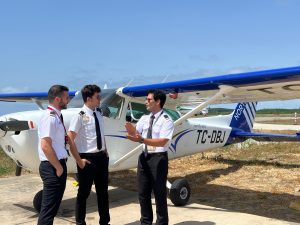
Begin Flight Training
Practical instruction introduces students to aircraft handling under the supervision of certified flight instructors.
Early lessons include:
- Pre-flight inspection
- Taxi procedures
- Straight-and-level flight
- Climbs and descents
- Turns
- Stalls
- Takeoffs
- Landings
- Radio communication
Each lesson builds confidence while reinforcing safe operational habits.
Perform Solo Flights
One of the most memorable milestones in pilot training is the first solo flight.
Before authorizing solo operations, instructors evaluate the student’s ability to:
- Maintain aircraft control
- Follow air traffic instructions
- Handle emergencies
- Complete safe takeoffs
- Execute consistent landings
Solo flights demonstrate independent competence while remaining within instructor-approved limits.
Pass the Knowledge Examination
Most aviation authorities require applicants to complete a written knowledge examination covering theoretical aviation subjects.
Preparation includes:
- Practice examinations
- Flight planning exercises
- Airspace interpretation
- Navigation calculations
- Weather analysis
Consistent study dramatically improves examination performance.
Complete the Practical Flight Test
The final evaluation combines oral questioning with an in-flight practical assessment.
The examiner evaluates:
- Aircraft preparation
- Navigation
- Communication
- Flight maneuvers
- Emergency management
- Decision making
- Safety awareness
Successful completion results in the issuance of the pilot certificate.
How to Become a Pilot in Turkey
Turkey has become one of Europe’s fastest-growing aviation markets. The country’s expanding airline industry creates increasing demand for qualified commercial pilots.
Individuals wishing to become professional pilots in Turkey typically follow licensing standards regulated by the Turkish civil aviation authority in accordance with European Aviation Safety Agency (EASA) requirements.
Choose the Right Training Path
Future pilots generally select one of two educational routes.
Integrated Training
Integrated programs provide a structured curriculum from beginner to commercial pilot within a single academy.
Advantages include:
- Faster completion
- Organized curriculum
- Airline-oriented preparation
- Continuous instructor support
Modular Training
Modular training allows students to complete licenses step by step.
Benefits include:
- Flexible scheduling
- Lower upfront investment
- Ability to study while working
- Personalized learning pace
Both pathways ultimately lead to professional qualifications.
Meet English Language Standards
English proficiency remains one of the most important requirements for airline employment.
Pilots communicate with international air traffic controllers using standardized aviation phraseology.
Strong English skills improve:
- Flight safety
- International employment opportunities
- Simulator performance
- Technical knowledge acquisition
Many Turkish flight schools include aviation English courses throughout training.
Build Flight Experience
After earning a Commercial Pilot License, pilots continue accumulating flight hours.
Common methods include:
- Flight instruction
- Charter operations
- Corporate aviation
- Aerial surveying
- Cargo operations
Flight hours remain one of the strongest indicators of pilot experience during airline recruitment.
Obtain Type Rating
Airlines operate specific aircraft models requiring dedicated training.
Examples include:
- Airbus A320
- Boeing 737
- Embraer E190
- ATR 72
Type rating combines classroom instruction, full-flight simulator sessions, emergency training, and supervised line flying.
Apply to Airlines
Once all licensing requirements are complete, pilots may begin airline recruitment.
Selection processes commonly include:
- Technical examinations
- English assessments
- Simulator evaluations
- Psychological testing
- Human resources interviews
- Medical reassessment
Preparation significantly improves hiring success.
Career Opportunities After Obtaining a Pilot License
Professional pilots enjoy a wide range of aviation careers beyond airline operations.
Potential career paths include:
- Commercial airline pilot
- Cargo pilot
- Business jet pilot
- Flight instructor
- Corporate aviation pilot
- Air ambulance pilot
- Government aviation pilot
- Aerial photography pilot
- Agricultural aviation
- Search and rescue operations
The aviation industry offers continuous advancement opportunities as experience grows.
Skills Every Successful Pilot Develops
Flying involves much more than manipulating aircraft controls.
Professional pilots continuously strengthen:
- Situational awareness
- Communication
- Leadership
- Risk assessment
- Decision making
- Workload management
- Technical knowledge
- Stress management
- Crew resource management
- Adaptability
Training Costs and Financial Planning
Pilot training represents a significant financial investment.
The total cost depends on several factors:
- Country
- Flight school
- Aircraft type
- Fuel prices
- Simulator availability
- Additional ratings
Many students reduce financial pressure through:
- Aviation scholarships
- Student loans
- Airline sponsorship programs
- Cadet pilot programs
- Modular training
Careful budgeting prevents interruptions during training.
Technology Is Transforming Pilot Training
Modern aviation training has evolved dramatically over the past decade.
Today’s students benefit from:
- Full-motion simulators
- Virtual reality familiarization
- Electronic flight bags
- GPS-based navigation training
- Digital flight planning software
- AI-supported learning platforms
These technologies improve learning efficiency while reducing operational costs.
Industry research consistently shows that simulator-based training enhances emergency preparedness and procedural accuracy before students encounter real-world situations.
Expert Tip
Choose your flight school based on instructor quality rather than the lowest tuition.
Experienced instructors help students develop safer habits from the beginning. High-quality instruction often reduces the number of additional training hours needed before examinations, making it a smarter long-term investment.
Important Things to Consider
Before committing to flight training, evaluate every aspect of the program carefully.
Pay close attention to:
- Instructor availability
- Aircraft maintenance standards
- Weather conditions at the training airport
- Hidden fees
- Aircraft scheduling
- Student success rates
- Airline partnerships
- Safety culture
A transparent school usually provides detailed cost breakdowns and realistic completion timelines.
Common Mistakes Future Pilots Make
Many students unintentionally delay their progress by making avoidable mistakes.
Choosing a School Based Only on Price
Lower tuition does not always mean better value. Poor instruction may require additional flight hours that increase total costs.
Ignoring English Skills
Technical knowledge alone cannot compensate for weak communication abilities during international operations.
Delaying Medical Certification
Some students begin training before confirming medical eligibility. Completing the medical examination first minimizes financial risk.
Inconsistent Study Habits
Ground school requires continuous learning. Waiting until examination week often results in lower scores and increased stress.
Neglecting Physical Health
Fatigue, poor nutrition, and inadequate sleep directly affect learning performance and flight safety.
Future Demand for Professional Pilots
Global aviation continues to expand despite periodic economic fluctuations.
Industry forecasts estimate that airlines worldwide will require hundreds of thousands of new pilots over the next two decades due to:
- Fleet expansion
- Pilot retirements
- Growing passenger demand
- Cargo transportation growth
- Regional airline development
These trends make professional pilot training an attractive long-term career investment for qualified candidates.
Why Pilot Training Requires Lifelong Learning
Receiving a license marks the beginning—not the end—of aviation education.
Professional pilots regularly complete:
- Recurrent simulator training
- Safety seminars
- Emergency procedure reviews
- Aircraft systems updates
- Regulatory training
- Line checks
Continuous education keeps pilots current with evolving technology, regulations, and operational procedures.
Conclusion
An aircraft pilot license represents far more than permission to operate an aircraft. It reflects dedication, discipline, technical competence, and a strong commitment to aviation safety. Whether your goal involves recreational flying or commanding commercial airliners, following a structured training pathway builds the knowledge and confidence required for long-term success.
Investing in a reputable flight school, maintaining excellent study habits, strengthening English communication skills, and accumulating quality flight experience will significantly improve your career prospects. Aviation rewards individuals who remain committed to continuous learning, professionalism, and safe decision-making throughout every stage of their flying journey.
Bizi instagramdan takip edin: northfly
Frequently Asked Questions
The timeline depends on the type of license and training schedule. A Private Pilot License often takes several months, while commercial airline training may require 18 to 24 months or longer.
Yes. Many aviation authorities do not require a university degree for pilot licensing. However, some airlines prefer candidates with higher education, especially for competitive recruitment programs.
Yes. English serves as the international language of aviation. Pilots must communicate clearly with air traffic control and understand technical manuals, making strong English proficiency essential.
A Private Pilot License allows individuals to fly for personal purposes but not for compensation. A Commercial Pilot License permits pilots to earn income through professional flying activities after meeting additional training and experience requirements.