Advantages of Studying at a Flight Academy
Choosing a professional flight school offers aspiring pilots a structured path toward aviation careers, combining theoretical knowledge, practical flight experience, instructor guidance and career-oriented training. The Advantages of Studying at a Flight Academy become especially clear when students compare organized academy programs with less structured training options.

Flight Academy Admission Requirements
Every flight academy sets its own admission standards, but professional pilot training generally requires students to meet certain academic, medical, language and age-related conditions. Understanding these requirements before applying helps candidates avoid unnecessary delays and choose a program that matches their career goals.
Most academies expect applicants to have completed the required level of secondary education. Some integrated airline pilot programs may also evaluate mathematics, physics and English knowledge because these subjects support later training in aerodynamics, navigation, aircraft performance and aviation regulations.
Aviation also places significant emphasis on medical fitness. Students who want to pursue a professional pilot career usually need an appropriate aviation medical certificate before investing heavily in their training. A medical assessment can identify potential limitations early and give candidates a clearer picture of their eligibility.
English proficiency also plays a major role. Pilots communicate internationally using aviation English, and students encounter English terminology throughout flight training, examinations, manuals and cockpit procedures.
Before applying, candidates should check:
- Minimum age and education requirements
- Aviation medical certification requirements
- English language expectations
- Entrance examinations or interviews
- Financial requirements and payment plans
- Required documents
- Flight training prerequisites
- Program duration and estimated flight hours
- Licensing pathway after graduation
Expert Tip: Complete the medical assessment as early as possible. Spending money on training before confirming your medical eligibility can create avoidable financial and career risks.
Flight Training Programs
Flight academies typically offer several training pathways depending on the student’s objectives. A person who wants to fly recreationally may choose a private pilot program, while someone targeting an airline cockpit needs a much more comprehensive professional training route.
A structured academy program usually combines ground school with practical flight instruction. Students learn subjects such as aircraft systems, meteorology, air law, navigation, human performance, communications and flight planning before applying this knowledge during actual flights.
Common training pathways include:
- Private Pilot Licence (PPL)
- Commercial Pilot Licence (CPL)
- Instrument Rating (IR)
- Multi-Engine Rating
- Airline Transport Pilot Licence (ATPL) theory
- Integrated airline pilot programs
- Modular professional pilot training
Each route serves a different purpose. A PPL provides a foundation for private flying, whereas professional programs progressively develop the skills required for commercial aviation.
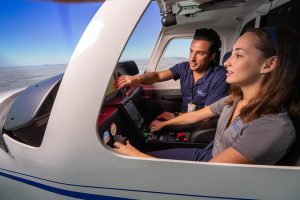
Integrated and Modular Training
Students often compare integrated and modular flight training when choosing an academy. Integrated programs follow a predefined curriculum and normally guide students through multiple stages under one coordinated training structure.
Modular training offers greater flexibility because students complete individual qualifications and ratings progressively. This option can suit candidates who want to manage their training around work, education or personal financial circumstances.
| Training Approach | Main Advantage | Suitable For | Key Consideration |
|---|---|---|---|
| Integrated Program | Structured progression | Full-time aspiring airline pilots | Requires strong time commitment |
| Modular Training | Flexible progression | Students balancing other commitments | Requires careful planning |
| PPL Training | Entry into private aviation | Recreational pilots | Does not provide an airline career by itself |
| CPL Training | Professional flying pathway | Commercial pilot candidates | Requires additional ratings and experience |
| Instrument Training | All-weather operational skills | Professional and advanced pilots | Demands strong theoretical knowledge |
| Multi-Engine Training | Twin-engine experience | Airline-oriented candidates | Builds advanced aircraft handling skills |
The right option depends on the student’s career target, available budget, schedule and previous aviation experience.
What Makes a Flight Academy Different?
One of the most important benefits of an academy lies in its structured learning environment. Instead of approaching each training requirement independently, students follow a curriculum that connects theoretical lessons with practical flying.
This structure can improve learning efficiency. A student who studies navigation in the classroom can apply those concepts during flight planning and later practice them in the aircraft with an instructor.
Professional academies also create a training culture that resembles the operational environment of commercial aviation. Students learn to follow standard operating procedures, communicate effectively, manage workload and make decisions according to established safety principles.
These habits matter because modern airline operations rely heavily on consistency, teamwork and disciplined decision-making.
Access to Experienced Flight Instructors
Instructor quality can strongly influence a student’s development. A good flight instructor does more than demonstrate how to control an aircraft; the instructor explains why pilots make particular decisions and helps students develop sound judgment.
During training, instructors evaluate areas such as:
- Aircraft handling
- Situational awareness
- Radio communication
- Navigation
- Decision-making
- Emergency procedures
- Crew resource management
- Flight preparation
- Operational discipline
Students also benefit from repeated feedback. An instructor can identify small weaknesses before they become established habits, allowing the student to correct them during subsequent flights.
Professional Advice: Do not measure an instructor only by how many flight hours they have. Communication skills, teaching ability, patience and the quality of feedback can make an equally important difference to a student’s progress.
Modern Aircraft and Flight Simulators
Another major advantage comes from access to aviation training equipment. Established flight academies can provide aircraft fleets, briefing facilities, navigation equipment and flight simulation resources designed around the training syllabus.
Flight simulators allow students to practice situations that would be difficult, expensive or inappropriate to reproduce during ordinary flight. These sessions can cover instrument approaches, abnormal situations, cockpit procedures and decision-making exercises.
Simulation also helps students develop cockpit familiarity before they encounter certain situations in real aircraft. When students combine simulator sessions with actual flying, they can reinforce procedures from multiple learning environments.
However, simulation should complement real flight experience rather than replace it. Aircraft handling, weather awareness and real-world workload create learning experiences that students cannot completely reproduce in a simulator.
A Clearer Path Toward a Pilot Career
Many aspiring pilots choose an academy because they want a clear progression from beginner training toward professional aviation. A well-designed program can connect early training with later qualifications such as CPL, IR, multi-engine training and ATPL theory.
This progression helps students understand what they need at each stage. Instead of treating each licence as an isolated achievement, students can build a long-term roadmap toward their intended aviation career.
Career-oriented academies may also provide guidance about:
- Airline recruitment processes
- Pilot licence requirements
- CV preparation
- Interview techniques
- Simulator assessments
- Aviation English
- Crew resource management
- Professional pilot competencies
This guidance can become particularly valuable near the end of training, when students transition from student pilot to commercial aviation candidate.
Developing Professional Aviation Skills
Flying an aircraft requires more than technical control. Professional pilots need to manage information, communicate clearly, anticipate risks and make decisions under changing conditions.
Flight academy training encourages students to develop these skills through classroom instruction, flight exercises, simulator sessions and instructor feedback.
Students gradually strengthen:
Decision-making: Pilots learn to evaluate weather, aircraft performance, fuel requirements and operational risks before and during a flight.
Situational awareness: Students learn to monitor the aircraft, environment, navigation information, traffic and changing operational conditions.
Communication: Aviation requires precise communication between pilots, air traffic controllers, cabin crew and other operational teams.
Workload management: Pilots must prioritize tasks and maintain control of the aircraft even when several demands appear simultaneously.
These competencies can significantly influence a pilot’s professional development because airlines evaluate much more than basic aircraft handling.
Networking and Aviation Community
A flight academy also places students inside an aviation environment. They train alongside other aspiring pilots, interact with instructors and encounter professionals who understand the realities of the industry.
This environment can create useful professional connections. Students may exchange experiences, learn about different career paths and gain insight into airline recruitment expectations.
The aviation community can also motivate students during challenging stages of training. Flight training requires persistence, and learning alongside people who share similar goals can help students maintain discipline.
Safety-Focused Training Culture
Safety represents one of the most important elements of professional pilot education. A quality academy encourages students to think about risk before problems occur.
Students learn concepts such as threat and error management, checklist discipline, weather assessment, aircraft limitations and emergency procedures. They also learn that a safe pilot does not simply react to problems but actively identifies potential risks before they develop.
Important: Students should evaluate an academy’s safety culture before choosing a school. Ask about aircraft maintenance practices, instructor qualifications, operational procedures, safety reporting and how the academy handles weather-related cancellations.
Cost, Time and Career Planning
Flight training represents a significant investment, so candidates should look beyond the advertised tuition price. The total cost may also include medical examinations, examination fees, accommodation, equipment, uniforms, licences, additional flight hours and other administrative expenses.
Training duration can vary considerably. Weather, aircraft availability, student progress, examination schedules and operational factors can influence the overall timeline.
Before signing an agreement, ask the academy for a detailed financial and training plan. A transparent school should explain what the advertised package includes and which expenses students may need to pay separately.
Questions Worth Asking Before Enrollment
A short consultation can reveal important differences between flight academies. Candidates should ask:
- Which licences and ratings does the program include?
- How many flight hours does the advertised price cover?
- What happens if additional training becomes necessary?
- Which aircraft models do students fly?
- How frequently can students expect to fly?
- What simulator facilities does the academy provide?
- What qualifications do the instructors hold?
- How does the academy handle bad weather?
- What career guidance does the school offer?
- What additional costs should students expect?
Comparing these answers can provide a much more realistic picture than comparing tuition prices alone.
Common Mistakes When Choosing a Flight Academy
Some candidates focus almost entirely on price. Although budget matters, the cheapest program does not always provide the best overall value.
Another common mistake involves choosing an academy without researching its training environment. Students should examine the fleet, instructor structure, scheduling system, maintenance standards and overall reputation before making a commitment.
Other mistakes include:
- Starting training without checking medical eligibility
- Underestimating the importance of aviation English
- Ignoring additional costs
- Choosing a program without a clear career objective
- Assuming every academy offers the same training quality
- Focusing only on advertised flight hours
- Failing to ask about aircraft availability
- Treating theoretical education as less important than flight practice
A thoughtful decision at the beginning can prevent major difficulties later.
The Long-Term Advantages of Flight Academy Education
The value of academy training extends beyond earning a licence. Students develop habits that can influence their entire aviation career.
A structured environment teaches candidates to prepare thoroughly, follow procedures, communicate clearly and evaluate risks systematically. These habits remain relevant when pilots move from training aircraft to more complex commercial operations.
The academy also provides a controlled environment where students can make mistakes, receive feedback and improve before facing the greater responsibilities of professional flying. This gradual development represents one of the strongest reasons candidates choose formal flight education.
Is Flight Academy Training Worth It?
For candidates who want a professional aviation career, flight academy training can offer a practical combination of structured education, flight experience, instructor support, simulator training and career preparation.
The best academy depends on the student’s individual circumstances. Someone interested in recreational flying may need a very different program from a candidate targeting an airline career.
Expert Tip: Choose the training pathway first and the academy second. Define your long-term licence and career objectives, calculate the complete expected cost, check medical eligibility and then compare academies according to training quality rather than price alone.
Bizi instagramdan takip edin: northfly
FAQs
A flight academy provides structured theoretical education, practical flight training, instructor guidance, simulator experience and a clearer progression toward professional pilot qualifications.
Most beginner-oriented programs do not require previous flight experience. Students can start with foundational training and progressively develop their aviation knowledge and flying skills.
Consider your career objective, budget, schedule and desired licence. Candidates targeting airlines generally need a more comprehensive professional pathway than students who only want to fly privately.
Yes. Simulators allow students to practice procedures, instrument flying, abnormal situations and cockpit workload in a controlled environment. They work best alongside regular aircraft training.