
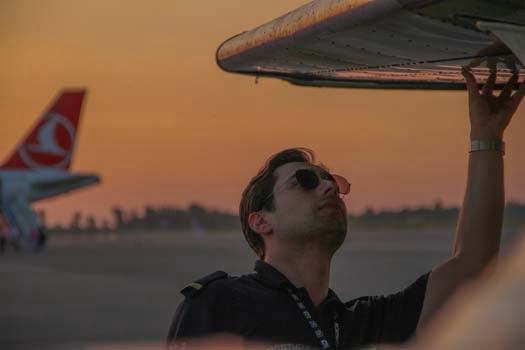
Why Study Aviation in İstanbul?
İstanbul offers a strong environment for aviation education because the city connects major international air routes, hosts two major airports, and provides access to flight schools, aviation academies, instructors, and a large industry network. For students who want to become professional pilots, study aviation in İstanbul can provide both structured training opportunities and valuable exposure to a highly active aviation market.
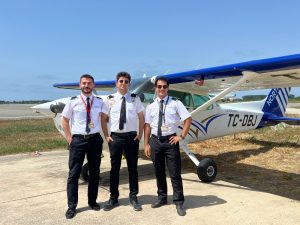
Why Choose İstanbul for Aviation Education?
İstanbul stands out as one of Türkiye’s most important aviation centers. The city hosts İstanbul Airport and Sabiha Gökçen International Airport, creating a dynamic environment where students can observe airline operations, airport management, aircraft movements, and international aviation practices.
The scale of İstanbul’s aviation activity also gives the city a practical advantage. According to the Turkish Directorate General of Civil Aviation (DGCA), Türkiye’s aviation infrastructure continues to expand, while official DHMI data shows that İstanbul’s two airports handled more than 63.4 million passengers during the first half of 2026. This figure demonstrates the enormous scale of the city’s air transportation ecosystem.
For an aviation student, this environment can create opportunities beyond classroom education. Students can develop a better understanding of airline operations, aviation terminology, air traffic procedures, airport logistics, and the professional standards expected from commercial pilots.
Key Advantages of Studying Aviation in İstanbul
- Access to a major international aviation hub
- Flight training opportunities through authorized organizations
- Strong exposure to airline and airport operations
- International student environment
- Easy access to aviation-related companies and professionals
- Training programs for PPL, CPL, IR, ME and ATPL pathways
- Opportunities to improve professional aviation English
- Access to modern aviation infrastructure and training technologies
Another important advantage comes from İstanbul’s international character. Aviation operates through a global language and global procedures, so students benefit from regular exposure to different nationalities, cultures, and communication styles.
Pilot Training Requirements
Becoming a professional pilot requires more than simply learning how to operate an aircraft. Candidates must meet specific age, education, medical, theoretical knowledge, flight experience, examination, and licensing requirements established by the relevant aviation authority.
In Türkiye, the Directorate General of Civil Aviation, known as SHGM or DGCA in English, regulates pilot licensing and flight training organizations. Candidates should therefore verify that their selected school holds the necessary authorization before paying tuition or starting training. SHGM maintains an official list of approved training organizations.
For students considering different pilot licenses, the basic framework looks like this:
| Licence / Training | Minimum Age | Medical Standard | Main Purpose | Typical Flight Requirement |
|---|---|---|---|---|
| Student Pilot Licence | 16 before first solo | Class 1 or Class 2 | Starting flight training | Depends on program |
| PPL(A) | 17 | Class 1 or Class 2 | Private, non-revenue flying | Minimum 45 hours |
| CPL(A) | 18 | Class 1 | Commercial pilot privileges | 150 hours integrated / 200 hours modular |
| ATPL(A) | 21 | Class 1 | Airline transport pilot licence | 1,500 hours total experience |
The official DGCA requirements state that PPL applicants must be at least 17, hold the required medical certificate, complete authorized theoretical and flight training, pass the relevant examinations and skill test, and satisfy the required flight experience. PPL(A) training requires at least 45 hours of flight time.
For CPL training, candidates must be at least 18 and hold a valid Class 1 medical certificate. The DGCA specifies a minimum of 150 flight hours for an integrated CPL course or 200 hours for a modular course, with additional requirements for night qualification.
ATPL represents a higher professional level. Applicants must be at least 21, hold a high school diploma or equivalent, possess a valid Class 1 medical certificate, complete the required training, pass ATPL theoretical examinations, hold CPL and multi-engine instrument rating qualifications, complete an MCC course, and satisfy the required flight experience. The full ATPL(A) application requires at least 1,500 hours of flight experience, including at least 500 hours in multi-pilot operations.
English Language Skills in Aviation
English plays a central role in professional aviation. Pilots communicate with air traffic controllers, study technical manuals, review operational procedures, interpret weather information, and complete examinations through aviation terminology that relies heavily on English.
The DGCA emphasizes English proficiency within pilot education and notes that training, examinations, and professional documentation use English. ATPL examinations in Türkiye also include 14 theoretical subjects and take place in English.
Expert Tip: Do not wait until flight training starts to improve your English. Build your aviation vocabulary before entering the cockpit and practice listening, speaking, technical reading, and aviation phraseology regularly.
Useful areas to study include:
- Aviation English
- Radio communication
- Aircraft systems terminology
- Flight planning vocabulary
- Meteorology terminology
- Navigation terminology
- Emergency procedures
- Air traffic control communication
A student with strong English skills can understand training material faster and communicate more confidently during practical flight operations.
Flight Schools in İstanbul
İstanbul offers several options for students who want to pursue professional pilot training. However, the most important criterion should not simply be the school’s location or advertised price.
Students should first check whether the organization holds the appropriate DGCA authorization for the training they want to complete. The DGCA defines Approved Training Organizations as organizations authorized to provide pilot training under applicable national and international regulations.
İstanbul-based training options can include integrated ATPL programs, modular pilot training, PPL courses, CPL training, instrument rating, multi-engine training, night flight training, and ATPL theoretical education.
When comparing flight schools, students should examine the following factors:
- DGCA authorization and scope of approval
- Integrated or modular training structure
- Aircraft fleet and aircraft availability
- Instructor experience
- Flight scheduling system
- Simulator access
- Maintenance standards
- Training location
- Average training completion time
- Additional examination and administrative costs
- Accommodation and transportation options
- International licensing opportunities
- Career guidance and airline preparation
Important: A low advertised training price does not always represent the final cost. Students should request a complete cost breakdown covering flight hours, examinations, medical certification, licensing, accommodation, simulator sessions, additional flight hours, equipment, and possible retesting expenses.
İstanbul’s Aviation Ecosystem
One of the strongest reasons to study aviation in İstanbul comes from the city’s broader aviation ecosystem. A pilot student does not train in isolation; the surrounding professional environment can influence the way that student understands the industry.
İstanbul Airport operates as a major international aviation hub, while Sabiha Gökçen provides another significant center for passenger and airline activity. In the first six months of 2026, the two İstanbul airports served 63,447,607 passengers according to DHMI data.
This scale creates a valuable professional atmosphere. Students can encounter airline operations, ground handling, aircraft maintenance, airport security, aviation management, air traffic services, and other disciplines that support commercial aviation.
For international students, İstanbul can offer another advantage: the opportunity to combine aviation education with life in a major global city. The city provides extensive transportation, accommodation, cultural, educational, and social infrastructure, which can make long-term study more convenient.
Integrated vs. Modular Pilot Training
Students often struggle to choose between integrated and modular training. Both approaches can lead toward professional pilot qualifications, but they offer different structures.
Integrated training generally follows a planned curriculum from the beginning. The school organizes theoretical subjects and flight training as one connected pathway, which can make the process easier for students who want a structured airline-oriented program.
Modular training allows students to complete individual qualifications step by step. This approach can offer greater flexibility for candidates who want to manage their education around work, university, finances, or personal circumstances.
Professional Advice: Choose the training structure according to your financial situation, available time, learning style, and long-term career plan rather than choosing solely according to the advertised course price.
What Should You Check Before Enrolling?
Choosing a flight school represents a major financial and professional decision. A student should investigate the school carefully before signing a contract.
Ask the school for written information about:
- Total estimated training cost
- Included and excluded flight hours
- Aircraft types
- Instructor-to-student structure
- Average monthly flight availability
- Weather-related delays
- Simulator training
- Examination fees
- Medical requirements
- Licensing costs
- Additional flight-hour pricing
- Refund and cancellation conditions
- Training completion expectations
- International licence pathways
- Graduate career support
Students should also visit the school whenever possible. A personal visit can reveal details that an online advertisement cannot show, including the condition of training facilities, communication quality, administrative organization, and student support.
Common Mistakes Future Pilots Make
One of the most common mistakes involves choosing a school only because it advertises the lowest price. Flight training depends on aircraft availability, weather, maintenance, instructor capacity, and operational planning, so the cheapest initial quotation may not always produce the lowest final cost.
Another common mistake involves ignoring the medical examination until after registration. A candidate should investigate medical eligibility early, particularly when planning a professional pilot career that requires a Class 1 medical certificate.
Students also sometimes underestimate the importance of theoretical education. Aviation involves meteorology, navigation, aircraft systems, human performance, flight planning, air law, communications, and performance calculations. Strong theoretical knowledge directly supports safer and more confident cockpit performance.
Finally, some candidates treat English as a secondary skill. This approach can create difficulties later because aviation training and professional operations rely heavily on English terminology and communication.
Dikkat Edilmesi Gerekenler
Complete the medical assessment early. Do not make a major financial commitment before understanding whether you meet the relevant medical requirements.
Verify authorization. Check the current DGCA-approved training organization information before enrolling. Authorization can depend on the specific training privilege, so do not assume that every school can provide every licence or rating.
Understand the contract. Ask exactly what the advertised tuition includes and identify possible additional charges before signing.
Plan your finances realistically. Flight training can require additional hours if a student needs more practice than the minimum syllabus requires.
Develop professional English. Aviation English should become part of your routine from the beginning rather than something you study only before an examination.
Career Opportunities After Aviation Education
Pilot training can open the door to several professional pathways. Students who complete the appropriate qualifications and gain the required experience can pursue careers with airlines, charter operators, cargo companies, flight schools, aerial work organizations, and other aviation businesses.
A professional aviation career also involves continuous development. Pilots must maintain licences, complete recurrent training, pass required checks, maintain medical certification, and keep their technical knowledge current.
The aviation industry also offers opportunities outside the cockpit. Graduates interested in aviation can explore areas such as flight operations, aviation management, dispatch, safety, airport operations, aircraft maintenance coordination, and aviation training.
Is İstanbul a Good Choice for International Students?
İstanbul can appeal strongly to international students because it combines aviation infrastructure with a globally connected urban environment. The city provides international air connections, diverse accommodation options, extensive public transportation, and a multicultural social environment.
Students coming from abroad should consider visa requirements, accommodation, transportation to training facilities, medical certification, insurance, and the recognition of the licence they intend to obtain.
Expert Tip: International students should decide whether they want a Türkiye-focused licence pathway or an internationally transferable qualification before starting training. That decision can influence the choice of school, curriculum, examinations, licensing authority, and future career plan.
Why study aviation in İstanbul? The answer lies in the combination of strong aviation infrastructure, international connectivity, major airports, professional training organizations, and access to a broad aviation ecosystem. The city can provide an excellent environment for students who approach pilot training as a serious professional investment rather than simply an exciting experience.
The right flight school matters just as much as the city. Candidates should compare authorization, curriculum, aircraft availability, instructors, medical requirements, total costs, English support, training duration, and career pathways before making a decision. With careful planning and consistent preparation, İstanbul can become a strong starting point for a professional aviation career.
Bizi instagramdan takip edin: northfly
FAQs
Yes. İstanbul has two major airports, a large aviation ecosystem, international connectivity, and multiple aviation education options. These factors make the city attractive for students pursuing professional pilot training.
Candidates generally need to meet the minimum age and education requirements, obtain a valid Class 1 medical certificate, complete authorized theoretical and flight training, pass the required examinations and skill tests, and satisfy the applicable flight experience requirements.
The DGCA requires PPL(A) candidates to complete a minimum of 45 hours of flight training at an authorized organization. Additional training may apply for specific qualifications such as night flying.
Integrated training suits students who want a structured professional pathway from the beginning, while modular training offers greater flexibility because candidates complete qualifications in stages. The best option depends on your budget, schedule, previous experience, and career goals.